
Dialogue with Hu yuanyuan
In this issue, Long Space (L) speaks with artist Hu Yuanyuan (Hu) about the development of her exhibition project Irrelevant Events, exploring how, within unresolved contemporary conditions, one might understand the relationship between self, life, and the world.
(In the following text, Long Space is abbreviated as “L,” and the artist Hu Yuanyuan is abbreviated as “Hu.”)
L: How do reading and writing influence your artistic practice? Is this influence immediate and direct, or long-term and indirect? Could you give one or two specific examples?
Hu: For me, reading, diary writing, and drawing are not three separate activities with different functions, but rather a single daily, habitual practice. I prefer physical books and handwritten journals, and I am attached to the texture of paper and the act of writing itself. These help me remain calm and steady, allowing me to gradually understand emotions and clarify difficulties through repetition over time. The interaction between these three is, in my view, long-term, permeating, and tied to one’s overall state of being. I also enjoy watching television. When resting, I may watch for a long time without skipping commercials, opening titles, or end credits. I simply want to be in a completely still state: receiving information while also resting.
For example, the work Deadline originates from the to-do lists and time nodes I write in my diary each day. “Summary” Fragments comes from my resistance to standardized “annual summaries.” I reject defining or proving a year’s value through formatted documents and quantifiable results, so I instead use painting to organize narrative, perspective, and relationships. “The ‘Light Bulb Line’ of Coal Transport in Eastern Inner Mongolia” comes from a news image I happened to catch while watching television.
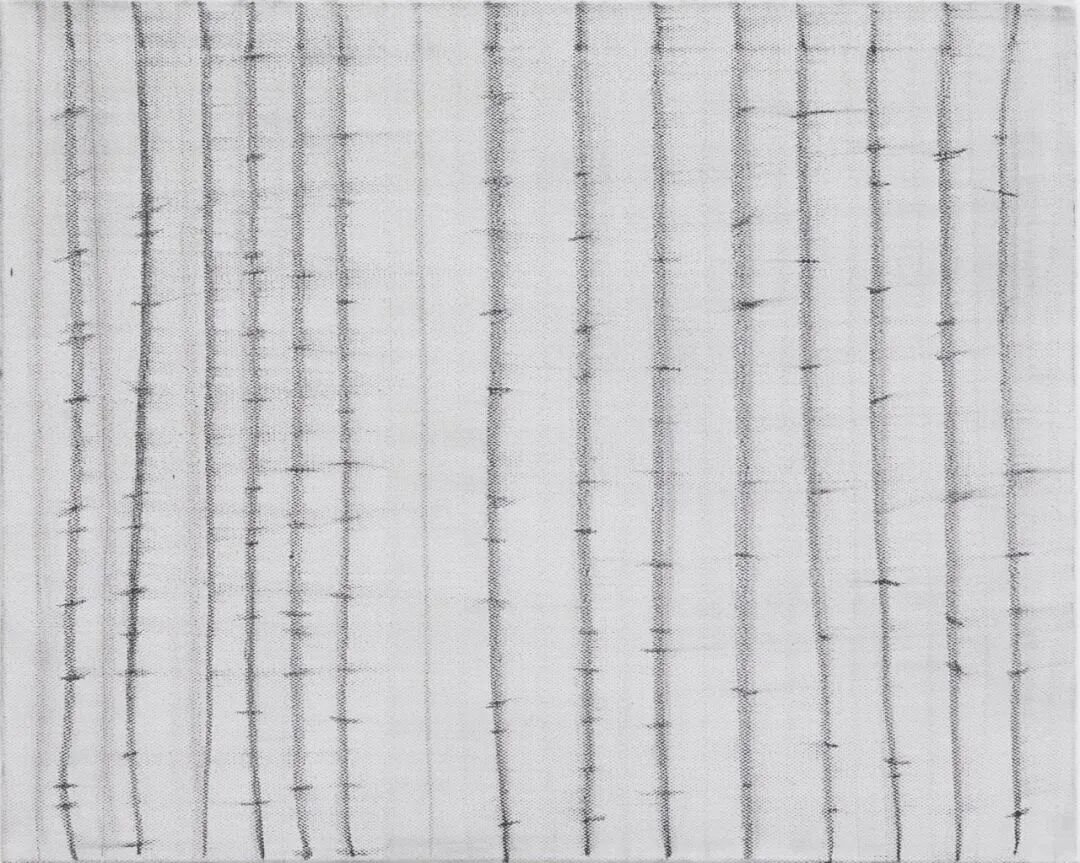
截止日期(Deadline)
2025, mixed media on canvas (charcoal pencil, charcoal stick), 40 × 50 cm
“总结”的片段("Summary" fragments)
2025, mixed media on canvas (oil pastel, pastel, charcoal stick), 40 × 50 cm
L: When you watch state news broadcasts and create paintings based on them, are you aware of their inherent bias and guiding function? Does that affect the objectivity of your work?
Hu: The bias and guidance of news broadcasts, in my view, are inherent attributes of mediated information—they are projections of discursive power in public communication. This question reminds me of the British series The Capture, where state authorities “correct” truth through operations. When I watch news or think about its relationship to my work, what I produce is a form of recording, retelling, or re-articulation—not a pure reproduction. What news presents is always a slice of reality from a particular perspective—the part we are meant to see. Absolute objectivity is impossible, because the “objectivity of events” is always relative. So whether something is objective does not trouble me. At the same time, I do not avoid the essential nature of events. I remain neutral. What I care about is how events become language, how language exists, and through this, how we reflect on our shared condition and what we might still be able to do.
L: You often use news images, many of which depict war. What draws you to these images?
Hu: My attention to news imagery is not limited to war, but extends to social events, infrastructure, and political issues—various fields of reality. I am not drawn to conflict or violence itself. Rather, these images confront the general condition of existence under modernity: real suffering, the instinctive human pursuit of stability and dignity, and the limits and inner dignity of individuals within larger political orders, historical structures, and social mechanisms. This suffering does not belong to any specific group or nation—it belongs to every individual. Suffering does not necessarily lead to nihilism or despair; instead, it can affirm resilience and the will to exist.
Through viewing and thinking, I can step outside personal emotions and localized experience, and understand the relationship between humans and the world from a broader perspective. Humans are always embedded in structures shaped by history, politics, society, and ideology. We are shaped by them, yet we also affirm ourselves within them. Humanity is interdependent, collectively bearing the fractures and traumas of civilization.
美国媒体公布画面(The US media released the footage)
2026, mixed media on canvas (acrylic, pastel, charcoal stick), 70 × 100 cm
L: Some of your titles are very direct and descriptive, while others are poetic. How do you understand this inconsistency? What is the relationship between a work and its title?
Hu: Some titles remain objective and straightforward, simply stating the event and its context, allowing the work to return to factual reality and maintain a documentary quality. Others are more metaphorical and poetic, expressing internal linguistic experience and feeling. This “inconsistency” depends on what the work seeks to express.
A title is not an after-the-fact explanation. Rather, it provides a linguistic space that opens up imagination and thought, forming an intertextual relationship with the image.
L: Your work stays closely connected to reality, yet also maintains distance from it. Why? How do you balance aesthetics and reality?
胡:Hu: I do not want to be deeply entangled in confrontational debates or conflicts. Maintaining distance allows me to remain clear-headed. Many real-world issues are entangled in predefined narratives and discursive structures. Only by keeping distance can one see their essence and think calmly.
Reality is full of noise and silence, joy and sorrow. The contradictions of being human persist throughout life. This balance, for me, comes from not strictly separating aesthetics and reality. Reality itself—its problems, phenomena, behaviors, and experiences—is the shared ground. It is both simple and solemn. Painting is simply my way of expression, just as sociologists analyze society, writers construct worlds through language, and musicians convey feeling through sound. I do not indulge in form or technique; using an appropriate mode of expression is enough.
美以将加沙局势推向何方(Where will the US and Israel lead the situation in Gaza?)
2025, mixed media on canvas (charcoal pencil, charcoal stick, pastel), 40 × 50 cm
以军近日袭击黎巴嫩画面(The recent attack by the Israeli army on Lebanon)
2025, mixed media on canvas (charcoal pencil, charcoal stick, pastel), 40 × 50 cm
L: Your work often juxtaposes trivial everyday objects with major historical events. Is there a connection between them?
Hu: What changes between them is not the objects themselves, but the distance and perspective of observation. Major events may be what Hannah Arendt describes as the manifestation of plurality and power in the public realm, revealing how historical narratives and social orders shape human conditions. Everyday objects, on the other hand, belong to personal habitation and ordinary life. Fundamentally, these seemingly opposite categories carry equal existential weight. They are different scales of the same structure of existence.
L: Your works tend to have a “gray” tone with soft edges. What are you trying to convey through this reduced contrast?
Hu: Perhaps it expresses a kind of gentleness and restraint in accepting complexity—complex situations and relationships. I have come to understand the boundaries of “disappearance”: the distance between self and others, and the shifting weight of time. All of this is temporary. I prefer to conceal interpretation and judgment within an atmosphere, expressing only a sense or feeling.
L: You use color very sparingly. Does too much color weaken your work?
胡:Hu: Rich colors make me uncomfortable. They feel too intense, unstable, or aggressive. I cannot name a favorite color, but I know what suits me and what a work requires. It is similar to my preference for northern climates.
L: You frequently use materials like charcoal, pastel, and crayon. Is this a trend, or a personal choice?
Hu: The word “trend” feels too heavy. These materials simply suit my expression and align with my concerns and inner state. Their texture is direct yet subtle, simple and gentle, and they are common in everyday life. There is also a sense of familiarity—when I first started drawing as a child, I used crayons and charcoal. Later, I would draw on blackboards at school. These materials carry that memory.
伊朗核设施资料(Lranian nuclear facilities information)
2026, mixed media on canvas (oil pastel, charcoal stick), 100 × 100 cm
L: Your work has a sense of ease and restraint. Many artists undergo strict academic training and later try to “forget” it. Your looseness seems natural. How did you achieve it?
Hu: Training is important, but what matters is what kind of training suits you and in what direction it develops. Training includes aesthetic judgment, visual experience, technical skills, willpower, and the ability to complete work with intention. The key is clarity of understanding and the ability to make choices. I do not believe artists must completely forget their training.
As for this sense of ease, it may come from my personality. I know what I do not want and what I want. I hope to remain focused and composed, and to move steadily toward spiritual and reflective expression.
L: What distinguishes your painting from traditional painting?
胡:Hu: I place greater emphasis on subject matter and concept. I want my paintings to be events—unfinished, questioning how meaning is generated, imposed, or suspended. I once encountered the ancient Hebrew word dabar, which means both “word” and “event.” In reality, many events exist as traces—they are silent, overlooked, and precede language, interpretation, and judgment. What I do is simply record events and reflect on them. This is, for me, the most fundamental way we face the world.
L: Your work seems to convey a sense of “emptiness.” Have you been influenced by Eastern philosophy or aesthetics?
Hu: The openness, blankness, and restraint in my work may indeed be interpreted as “emptiness,” but they likely come from my understanding of “void” and “stillness,” and an internal discipline. Chinese philosophy emphasizes emptiness as receptivity and stillness as a way to observe the mind. Only through emptiness and stillness can one perceive things in their true nature and confront existence directly. In my process, I try to remain fully conscious and self-aware, stripping away excess appearances and rejecting over-description or deliberate dramatization, allowing the spirit to emerge naturally at the edges of the image.
© All rights reserved by the artists and LongSpace