Serena Huang: Serena Huang: Ann M. Hue Concept Theatre Presents:
The fifth installment of Long Space’s Stairwell Video Project presents two works by artist Serena Huang:Another incident on another man in the same top(hereafterAnother)与 I can see you, the light, and a rope but still have to move a bit to your left: the play(hereafterThe play)Drawing from responses to the absurdities of everyday events, current news, and worldly events, Huang’s short films dismantle linear narratives within the flickering of light, challenging inherent assumptions around the nature of performance. She fractures the boundary between front and back stage into unstable fragments of perception, where events, meanings, and understandings are exposed on stage in a dispersed yet continuously impactful manner.
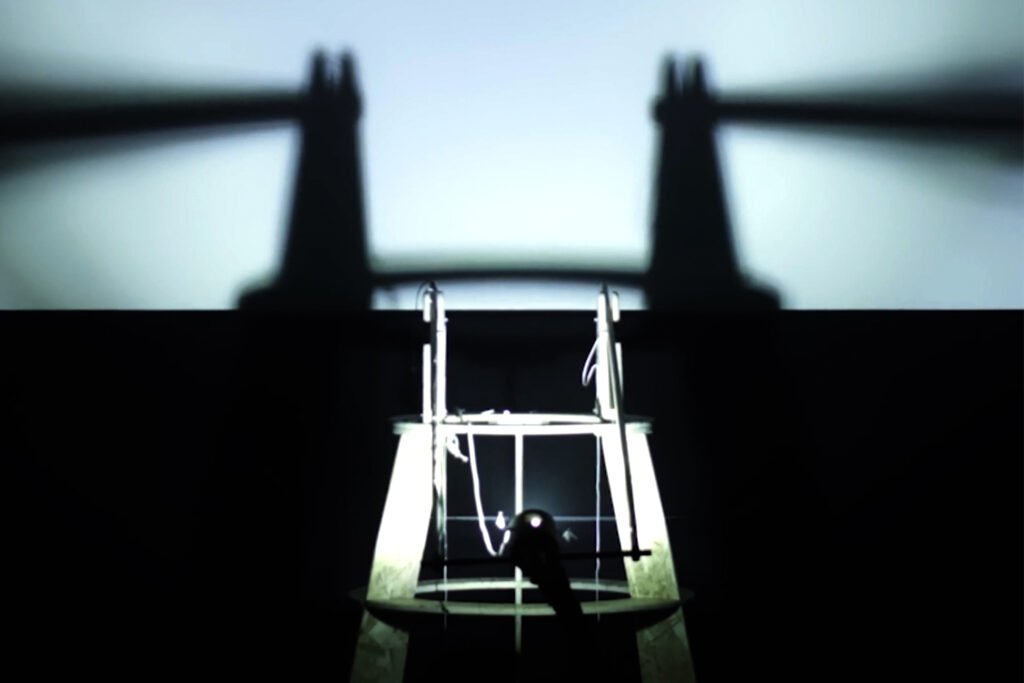
AnotherAnother originated in an act of accidental exploration. Entering the Royal College of Art’s moving image studio with no predetermined intention and began her creative experiments in this fully equipped space. Floodlights, fluorescent tubes, and halogen lamps,long relegated to the backstage infrastructure of production, displace the human subject and dominate the position of expression, interrogating whether narrative performativity can persist in the absence of organic agency, or whether, such continuity is necessary at all.
Walk in. Walk in. Walk towards the figure in the shadow. You can see them now. What are they. They are a piece of lighting equipment.
A click.
The light snaps on. They, it, raises its head and looks at you.
▲⻩鹄欣(Serena Huang), 在另⼀个穿着同样上⾐的⼈身上的另⼀个奇遇,Another incident on another man in the same top
2019, 影像, 7分02秒 T
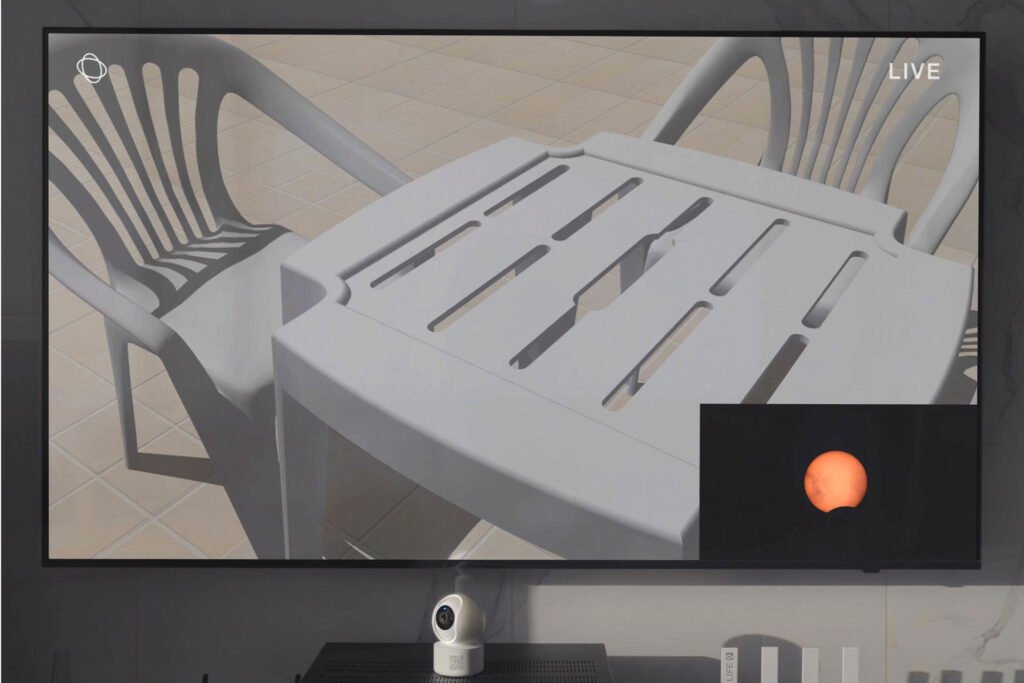
he playextends this inquiry into a more concrete examination of the relationship between front and back stage. The figure of the Kuroko, the backstage worker in traditional Japanese theatre and conventionally rendered invisible, steps forward to operate the wearable wooden spotlight, walking, lingering, and rotating across the stage, alternately illuminating the space and disappearing within it.
2019,影像9分02秒
The logic that attempts to explain narrative sequence applied above reveals itself, within Huang’s work, as simultaneously plausible and out of focus. Huang resists constructing a coherent narrative that an audience might fully comprehend, but rather the dramaturgical force of simultaneity, the moment when light, music, and movement erupt together. In that single instant, a sudden percussive accent, a gradual shift in vocal register, and an eruption of light collide by coincidence, dissolving the scene into fragments of experience. Both works find their theoretical grounding in Huang’s encounter with Taoist divination. She observed that the practitioner’s method of casting a hexagram is to attend to what occurs simultaneously with the moment of asking, and to divine accordingly based on what appears in that same instant. Thus, how the story unfolds is secondary; what matters is the transient in which the story and its world are contingently co-present.
Jung termed this phenomenon synchronicity that the meaningful coincidence of two causally unrelated events that nonetheless occur simultaneously. It is precisely within the arrival of synchronicity that Huang investigates how human emotion and the behavior of objects undergo their mutual transformation. The agents of this transformation are those figures long disregarded by the theatrical apparatus those unnoticed, unseen, deemed peripheral, the backstage. Rendering the invisible visible and endowing it with the performative functions of the front stage, constitutes Huang’s intervention into mise-en-scène. Her lights become actors, sound becomes plot, the Kuroko becomes protagonist, together producing a third space that holds both front stage and backstage in simultaneous tension, destabilising the singular definitions of theatre and installation alike, and opening onto a reimagining of light, theatricality, and musicality.
The narratives that audiences construct as their affective states shift alongside the light and sound may be nothing more than provisional hallucinations generated in the act of watching. They are real, since they are felt; they are fictitious, because the image never declared them. As with the title of this project, ‘Ann M. Hue’ is ‘human’ written in reverse. After the mirroring, is the subject still itself, or has it already been inverted into another image entirely? The question left suspended is whether the stories we perceive in the theatre, in thought, in the gaze, the front-stage narrative, the backstage truth, the figure caught in the light, are anything other than projections of our own presumed certainty.Ann M. HueThe narratives that audiences construct as their affective states shift alongside the light and sound may be nothing more than provisional hallucinations generated in the act of watching. They are real, since they are felt; they are fictitious, because the image never declared them. As with the title of this project, ‘Ann M. Hue’ is ‘human’ written in reverse. After the mirroring, is the subject still itself, or has it already been inverted into another image entirely? The question left suspended is whether the stories we perceive in the theatre, in thought, in the gaze, the front-stage narrative, the backstage truth, the figure caught in the light, are anything other than projections of our own presumed certainty.
展览 | 广州 弄空间 LongSpace
2026.4.25-6.15
弄空间
2026.04.21
文|周睿
编辑|Lucy
© All rights reserved by the artists and LongSpace